


Written by Cláudia Vieira
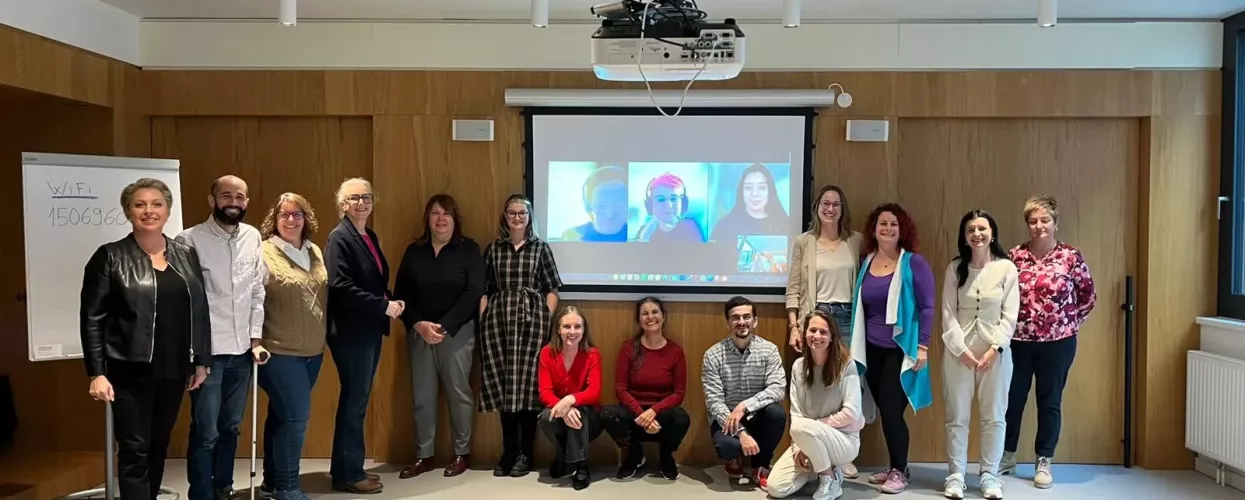
Last year brought one of the most meaningful learning experiences of my professional life. After applying through Mulheres à Obra to a programme run by Women 5.0, I was selected to join a European learning experience focused on how we can teach with AI and use digital tools more consciously.
The training took place in Vienna, Austria, over several days, with participants coming from across Europe. I had never participated in a programme like this before, especially outside of Portugal, and it was truly eye-opening. Beyond the content itself, what stayed with me most was the networking: listening to different perspectives, and understanding what education, entrepreneurship, and digital transformation look like in other European contexts.
Turning Learning into Practice
After the experience in Vienna, we had the chance to refine the materials we explored during the programme. Rather than letting the learning remain theoretical, we decided to test the content in a real setting.
In February, we created a two-day bootcamp designed for women entrepreneurs who wanted to understand digital tools and how those tools are shaping both business and daily life. Across the two days, we ran sessions as well as modules on practical topics, and we gathered feedback to understand what resonated and what needed improvement.
What We Heard from Women Entrepreneurs
One insight was strikingly consistent: many women face the same challenges and the same doubts, regardless of how experienced they already are with digital tools.
Even people who use digital platforms every day often carry a quiet fear about what the future might bring. Some hesitate to try new tools. Others wonder whether AI will complicate their work or change things too fast. But by the end of the bootcamp, something shifted. Participants were more willing to experiment because they realised they were not alone.
And the biggest mindset change was simple but powerful: the digital era is not “next.” It is now. With AI, it is increasingly impossible to avoid these changes. It is better to explore them, understand them, and learn how to use them in ways that support our goals.
A Human-Centered Philosophy for Digital Tools
Throughout this work, I keep returning to one principle: digital tools should help us live and work better.
They can support our businesses, but they can also support our well-being. Sometimes, using something digital is the best way to improve our non-digital life: simplifying tasks, reducing manual work, and making space for what matters.
Because what matters most is still human:
- Our ability to communicate with others
- Our creativity
- Our critical thinking
- Our capacity to think differently and build new perspectives
Tools can do the heavy and repetitive work. The thinking remains ours. I believe it always will.
Why European Learning Exchanges Matter
Looking back, the most incredible part was the exchange itself: the ideas, the conversations, and the perspectives shared with people from other countries. Of course, the materials we created will help other trainers and learners. But the deeper value was in understanding that across Europe many of us are asking the same questions.
If this experience taught me anything, it is that learning in international communities does more than improve skills. It reduces fear. It builds confidence. And it helps people move forward with curiosity instead of anxiety.