


Written by Sandra Couto
There are moments in adult education when learning goes far beyond acquiring knowledge or developing skills. Moments when it quietly reshapes how we see ourselves, our work, and the lives we are building.
For me, one of those moments happened through the Women 5.0 project.
I travelled to Vienna to take part in a Train the Trainer programme focused on business digitalisation and artificial intelligence, and their role in women’s entrepreneurship. At first glance, it was about self-organisation, tools, methodologies and new technologies. But what I found there was something much deeper — and much more important.
What stayed with me was not only what we learned, but how we learned together. The group was diverse — trainers from different countries, backgrounds and realities — each bringing their own voice, their own way of learning and teaching, and their own lived experience. In that space, learning became a shared construction. It was not about mastering content, but about expanding perspectives and, of course, helping future participants to be more successful in their individual paths.
It reminded me that adult education is not only about transferring knowledge. It is about creating environments where people feel safe enough to question, to share, and to grow. Their investment of time and mindset must be deeply respected.
And growth, in this context, is never just professional.
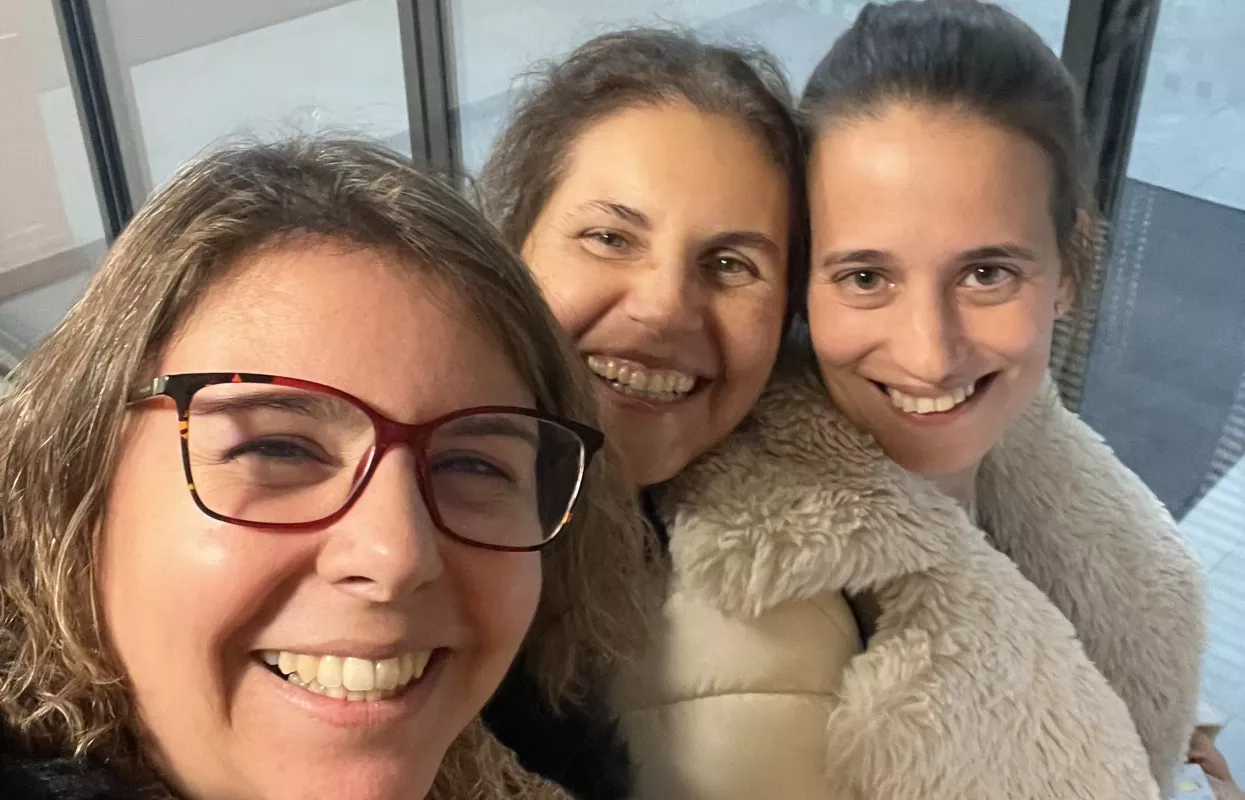
When I returned to Portugal, I carried that experience with me into our community, Mulheres à Obra, and also into my own, São Só Pessoas. Together with my colleagues, Camila Rodrigues and Cláudia Vieira, we delivered a two-day bootcamp to more than 40 women entrepreneurs, where we explored digital tools, productivity, wellbeing and the ethical use of technology.
But what truly mattered was not the tools themselves.
It was the moment when participants paused and reflected on their own relationship with work and technology. When they realised that productivity is not only about doing more, but about doing better — and, by doing so, living better. When they shared their doubts, their overload, and their desire for clarity and balance.
In those conversations, the boundary between professional development and personal wellbeing disappeared.
We were no longer just talking about entrepreneurship. We were talking about how to build a life that supports it. We were talking about not giving up, but bravely persevering and overcoming everyday challenges.
Projects like Women 5.0 show us that adult education can — and should — be a space for human development in the fullest sense.
They create bridges:
- between countries, through mobility and exchange,
- between women, through shared experiences and mutual support,
- and between knowledge and life, where learning becomes something we embody, not just apply.
For many of the women involved, these experiences are not just opportunities to learn new skills. They are moments of deep connection — with their confidence, their voice, and their place in the world. And also with each other, widening their business and personal relationships.
In a time when we often measure learning by its immediate impact on productivity, projects like this invite us to ask a different question:
What if learning is not only about working better, but about living a fuller life?
Because sometimes, the most important outcome of education is not what we do differently the next day — but who we become. And that, in itself, has the power to change the world.